Greenbelt Academy
PROGRAM GUIDE
Ministry (2026 / 2027)
Academics with the benefits of nature. A balanced approach to learning.
Welcome to Greenbelt
Welcome to the Greenbelt Academy family! We are excited for you and your child to begin their educational journey with us. Please find that our guide includes all the required information to ensure your child is prepared for Junior and Senior Kindergarten and you, as parents/guardians, know what to expect.
Mission – Education rooted in nature to inspire in our students a deeper connection to the community around them.
Vision – Every child is given the opportunity to learn about their world through daily access to extended time in nature. Quality educators facilitate an emergent curriculum that reflects the needs of the whole child and meets the demands of the world in which we live.
Thank You!
We are so excited your child is joining us!

How Does Learning Happen
at Greenbelt Academy & Early Learning Centre
At Greenbelt Academy we strive to meet our vision through hands-on experiential learning opportunities that follow the interests of the child, by allowing the curriculum to be fluid and built through observation and real life happenings. Teacher-led workshops and small group demonstrations are a mix of Ontario Curriculum , the Greenbelt Academy Development Checklist, and Forest School pedagogy, which offer new skills and address the needs of the whole child and realities of their community. We incorporate opportunities for risky play while in the forest and onsite, and offer multiple unstructured play sessions throughout the day. Our pedagogy places importance on developing emotional intelligence and we incorporate these skills into our lesson plans and responsive interactions with students. Through nature immersion, children develop environmental literacy which encourages them to grow to be humans who are authentically connected to the world around them and are more likely to care for and advocate for the future of our planet and their communities. Through our program(s), your child will be prepared with a solid foundation to support them down whatever path their education takes them.
“Unless we are willing to encourage our children to reconnect with and appreciate the natural world, we can’t expect them to help protect and care for it.” – David Suzuki

Why We’re The Right Choice
Our innovative teachers are registered Early Childhood Educators, Certified Ontario Teachers, Environmental Educators, Forest School Practitioners, or qualified in their field. We are dedicated to delivering high quality experiences through the application of the Forest School Canada Curriculum, the Ontario Curriculum, and our own Greenbelt Academy Development Checklist. This offers a balanced learning approach through a mix of hands-on teacher led and child directed opportunities.
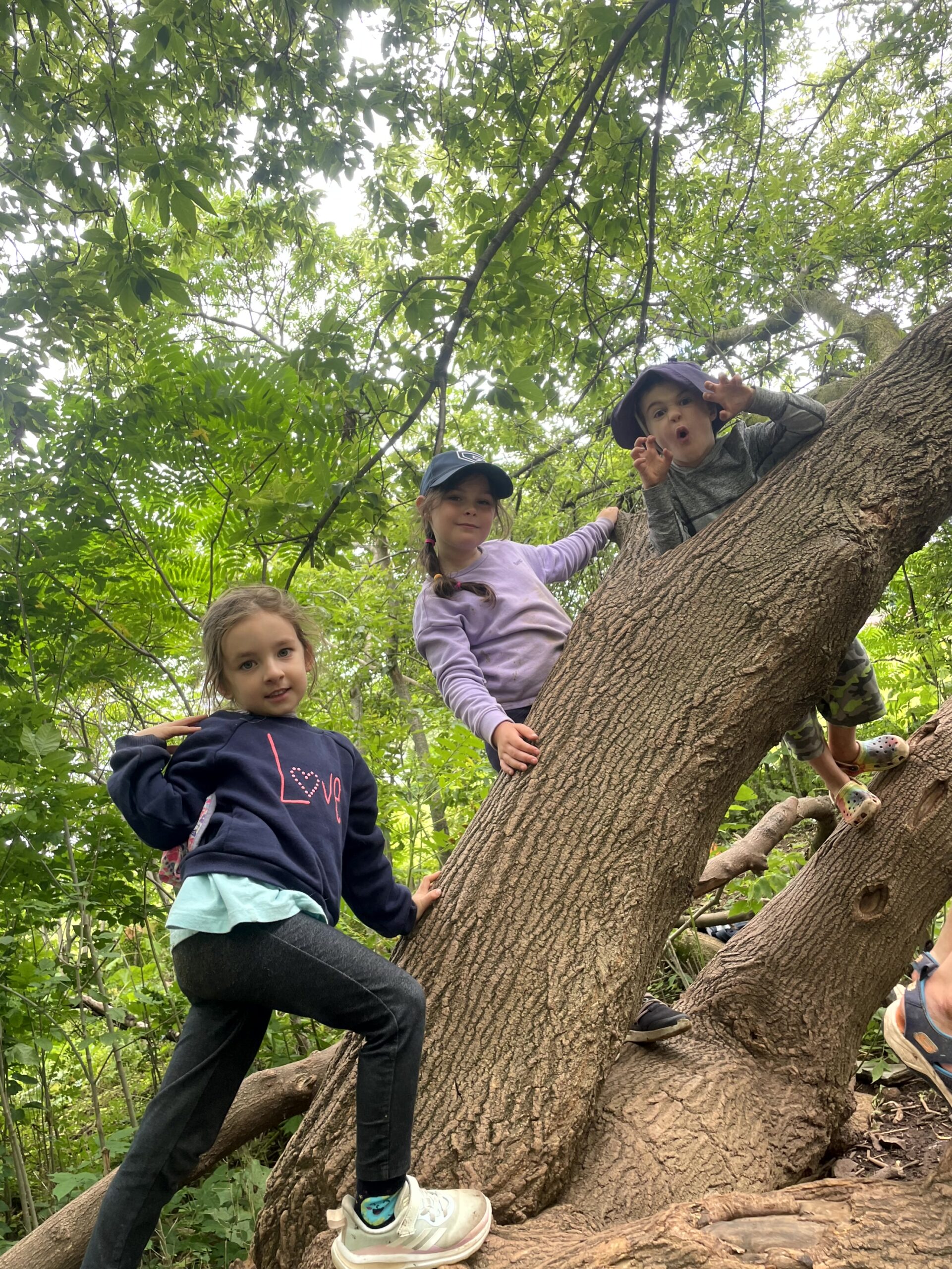
A minimum of 3 hours per day is spent outside unless dangerous weather prevents us. This integration with nature allows children to build resilience and self preservation as they navigate how to keep themselves comfortable and safe in the changing environment. Our indoor classrooms are set up to utilize and encourage the use of natural materials and tools for investigation (microscopes, computers), and to bring the outside indoors through intentional provocations that build on their current skills.
Our days vary throughout the week with two afternoons (Mon/Wed) and one full day (Fri) immersed in nature (Preschool & Kindergarten). During our time in the forest, Environmental Literacy workshops are offered, (Kindergarten offers application of skills onsite on Tuesday & Thursday afternoons). Free play is an important aspect of our program and children are given time each session to explore and engage freely (in the forest and at our home base).
Throughout the week, teacher directed workshops are offered based on Greenbelt Academy’s Development Checklist. These skill based workshops are hands-on , interest based and address the needs of the whole child. We regularly have experts from our community join us to share their skills and inspire us with new experiences. We also offer a World Discovery Day each month that gives students the opportunity to learn about the world beyond their own community.

Age and Enrollment of Children
Preschool Program “Seeds”
Ages 18 months to up 2.5 years
Our outdoor learning program provides children from ages 18 months up to 2.5 years with opportunities to engage with nature on a regular basis. Our full-day child-led, inquiry based program will focus on developing social, physical, cognitive, creative, and emotional well-being while fostering a connection with the world around them. We offer small class sizes (1:5 ratio) which provides educators with the opportunity to connect with and build upon children’s learning in our unstructured-play environment.

Preschool Program “Roots”
Ages 2.5 years up to 4 years
Our outdoor learning program will prepare our students for Kindergarten, with references to the Ontario Kindergarten curriculum as well as the Forest School Curriculum while introducing other learning theories to reinforce learning. We offer small class sizes (1:8 ratio) which provide educators with the opportunity to connect children with nature and build upon children’s interests while providing teacher-directed opportunities and offering an unstructured-play-based environment. Our days vary throughout the week with two mornings immersed in Nature offsite. Free play is an important aspect of our program and children are given time each day to explore and engage freely (in the Forest and at our home base).

Preschool – Sample Schedule
Sample Daily Schedule

Preschool Programs (Roots 1 & 2) walk to the forest two times per week to engage in nature immersion offsite.
Please note: During extended care which runs from 730-830, 5-530 groups may combine. During outdoor time, Roots 1 & Roots 2 programs may combine.
Kindergarten
Two Year Kindergarten Program
JK/SK (3.8 years up to 6 years)
Our two year nature-based full-time (M-F) Kindergarten Program offers an enriched learning experience during the most formative years of a child’s life.
Your child must be 4 years old by December 31st, 2026 to participate for the 2026/2027 school year.
We offer small class ratios (1:8), allowing us to apply the Ontario Curriculum and connect our learning to the world around us in an authentic and meaningful way.
What makes our program exemplary is our fluid approach to curriculum, which allows us to tailor our weekly focus in line with the child’s interest, real-life happenings, and development level. We offer self-directed outdoor play opportunities that encourage positive social competence and emotional intelligence, problem-solving and executive functioning skills, as well as autonomy. Our Teacher-directed sessions follow curriculum expectations and offer preparedness for a deeper exploration of their surroundings.
A minimum of 3 hours per day is spent outside unless dangerous weather prevents us. This integration with nature allows children to build resilience and self-preservation as they navigate how to keep themselves comfortable and safe in the changing environment. Our indoor classrooms are set up to utilize and encourage the use of natural materials and tools for investigation (microscopes, computers), and to bring the outside indoors through intentional provocations that build on their current skills.

Kindergarten – Sample Schedule
Sample Daily Schedule

Extended Care
Our Full-day program runs from 7:30am to 5:30pm.
Although there are no additional fees for drop off between 730 and 830am or pickup between 415 and 530pm, we ask all families to let us know if your child will be accessing our before or aftercare program in order for us to staff accordingly.
Thank you!
School Year Calendar
2026/2027
Fall term – September 8th, 2026 to December 18th, 2026
Winter term – January 4th, 2027 to March 12th, 2027
Spring term – March 22nd, 2027 to June 18th, 2027
Summer term – June 21st, 2027 to September 4th, 2027 (Preschool only)
School Closure Dates
- October 12th (Thanksgiving)
- Dec 21st-Jan 1st (Winter Break)
- Feb 15th (Family Day)
- March 15th-19th (March Break)
- March 26th (Good Friday)
- March 29th (Easter Monday)
- May 24th (Victoria Day)
- July 1st (Canada Day)
- August 2nd (Civic Holiday)
- September 6th (Labour Day)

Safe Arrival & Dismissal Policy
Parents must give Greenbelt Academy written authorization for the people who may have access to their children (i.e. a relative who picks up the child, emergency contact in cases where parents cannot be reached). If written authorization is not possible, the parent must phone or email us to give authorization. Parents must notify the school before changing the usual pickup routine. We always act in the best interests of the child if there is any confusion or uncertainty. Please see Greenbelt Academy’s Safe Arrival and Dismissal Policy:
Release of Children to a Person Who Appears Intoxicated/Impaired:
Staff will not release a child to a person who appears intoxicated or impaired. In such cases, staff will assist in making other pick-up arrangements (i.e. a spouse or other authorized person). Staff members are legally responsible to protect the children
Unauthorized Pick-up Procedure:
If someone other than a parent/authorized alternate pick-up person arrives to pick up a child and we haven’t been notified in advance by the authorized parent or pick up person we will:
- Call the guardian for verbal authorization.
- If a guardian cannot be located to give verbal approval, the child is not allowed to leave the premises until a guardian has been contacted.
- Greenbelt staff will remain with the child until an authorized pick-up person arrives. (see our safe arrival and dismissal policy for more details.
Custody and Access to Children:
According to the law, both parents of a child have equal access to a child and to the information about the child’s development, health and welfare. The only time a staff member can deny access of a parent to a child is when there is a written separation agreement or a legal court order. Greenbelt Academy requires a copy of this document

Registration Process & Waitlist
All parents must register on Niagara OneHSN (Niagara One List Website) and indicate that they are looking for full care and their preference in start date.
Please note that priority is given to current Greenbelt Academy families.
You will be contacted by the Program Supervisor or Director of the Preschool Programs when a space becomes available to you. Greenbelt Academy and Early Learning Centre offer registration for child care from our waiting list on a first-come, first-served basis, per the date registered on the list.
There shall be no charge or collection of a fee or deposit for the placement of a child on a waiting list for admission. Should the family decline the spot or wish to be removed from the waitlist then the available space will be offered to the next family on the list, meeting age appropriate program availability.
Parents will receive an admission package and information about the program when contacted via email. All forms must be returned before your child’s first day. It is essential that all information be completed, including payment, immunization records, and an emergency contact person to ensure the safety and security of your child.
Maximum Capacity of Centre
- “Seeds” Toddler Program- 18-30 months: 15
- “Roots- 1” Preschool Program- 30 months-4 years: 16
- “Roots- 2” Preschool Program- 30 months-4 years: 15
- Kindergarten Program- 3.8 years-6 years: 28

Admission and Discharge
A deposit and registration base fee of $300 is required and can be paid at the time of registration. This fee will be applied to your last invoice of care at Greenbelt Academy and Early Learning Centre. Please note that this deposit is only refundable (less $50 administrative fee) if one months written notice is given. We will not refund any deposit once received by GAELC if you change your mind about proceeding with registration.
Written notice of permanent withdrawal must be given four weeks in advance. If notice is not received, full program fees will be charged. Fees must be paid up to and including your child’s last day, prior to withdrawal. Please note that we do not offer refunds for any already accepted monthly tuition payments, and one-month tuition will be held for term and yearly payment options.
A permanent space cannot be guaranteed if you wish to temporarily withdraw your child. Therefore, your child will be placed on a waiting list. Greenbelt Academy and Early Learning Centre may terminate services if policies are not followed, fees are not paid or if the program is unsuitable for the child. If a child is absent from school for more than 30 days due to illness, the parent is required to give written notice, plus a doctor’s note and the child’s place will be held.
Payment of the fees is still required. In the event the child withdraws due to illness, 30 days written notification is required and the remaining fees will be refunded.
We encourage you to call or email us if you have any further questions.
905-931-0447
Greenbeltniagara@gmail.com

Tuition Rates
Greenbelt Academy and Early Learning Centre has enrolled in the Canada-wide Early Learning and Child Care (CWELCC) System between the Province of Ontario and the Government of Canada. We believe that our program provides a strong foundation for early childhood development and well-being of children. We are committed to providing childcare services that meet the needs of families in Niagara. Participating in the CWELCC System helps us to further our vision of giving every child the opportunity to learn about their world through daily access to extended time in nature.
- Daily Rate (Base Fee): $78/day
- Current rate with CWELCC subsidy: $22/day
Seeds, Roots, & Kindergarten Programs-Full Time
$440.00 monthly

Payment Plan Options
Monthly plan – Your monthly statement will be calculated based on the average number of days attended per month – this means your monthly statement will be the same every month regardless of holidays, closures, months with more weeks, etc.
Tuition payment (base fees) are due on the 1st of every month, unless you have already paid for the full year. Late payments will be subject to penalties. Please see our Late Payment Policy for more information.
Late Payment Policy (non base fees). Late payments may be subject to the following penalties: Up to one week late- 1% of invoice
Over one week-1% of invoice for every day late
Refund Policy
Any refunds issued will be subject to a $50 administration fee (unless otherwise stated).
Absences – NO REFUND for absence due to illness. In extreme circumstances that may prevent a child from participating, Greenbelt Academy reserves the right to determine and assess these circumstances on a case-by-case basis.
Vacations – NO REFUND for absence due to vacation. We ask that you let us know a minimum of one week if your child will be away due to vacation.
Inclement Weather – NO REFUND if the day’s program is canceled due to inclement weather. Parents will be notified within an hour of, by their child’s teacher via email or through HiMama.
Unforeseen Closures – NO REFUND if the day’s program is cancelled due to unforeseen closures. These closures include but are not limited to: Pandemic, water main burst, electrical disturbances, etc.
Withdrawing Your Child from Care – We require one month’s written notice if you plan to withdraw your child from Greenbelt Academy and Early Learning Centre for any reason. Please note that we do not offer refunds for any already accepted monthly tuition payments, and one-month tuition will be held for term and yearly payment options.

Anti-Harassment at Greenbelt Academy
Greenbelt Academy and Early Learning Centre is committed to ensuring an environment free of harassment, bullying, and discrimination. In pursuit of this, Greenbelt Academy and Early Learning Centre will not tolerate any harassment, bullying, or discrimination at our Centre. Greenbelt Academy and Early Learning Centre is further committed to investigating any complaints regarding harassment, bullying, and/or discrimination.
Canada’s Criminal Code specifically lays out matters such as violent acts, sexual assault, threats, and behaviours such as stalking. In the event of any of the above, Greenbelt Academy and Early Learning Centre will immediately contact the police.
SCOPE
This anti-harassment policy is applicable to all employees at Greenbelt Academy and Early Learning Centre and covers occurrences of workplace harassment from all sources, such as customers, clients, the employer, supervisors, workers and members of the public.
DEFINITIONS
Harassment is defined by the Ontario Occupational Health and Safety Act as “engaging in a course of vexatious comment or conduct against a worker in a workplace that is known or ought reasonably to be known to be unwelcome.” This definition includes sexual harassment, personal harassment, psychological harassment, and bullying.
Workplace harassment does not include reasonable actions taken by an employer or supervisor relating to the management or direction of workers in the workplace.
Sexual Harassment under the Occupational Health and Safety Act is defined as: “Engaging in a course of vexatious comment or conduct against a worker in a workplace because of sex, sexual orientation, gender identity or gender expression, where the course of comment or conduct is known or ought reasonably to be known to be unwelcome, or making a sexual solicitation or advance where the person making the solicitation or advance is in a position to confer, grant or deny a benefit or advancement to the worker and the person knows or ought reasonably to know that the solicitation or advance is unwelcome.”
Note that this Anti-Harassment Policy is administered in conjunction with Greenbelt Academy and Early Learning Centre’s Human Rights Policy and includes freedom from discrimination under any of the grounds established by the Ontario Human Rights Code, including race, ancestry, place of origin, colour, ethnic origin, citizenship, creed (religion), sex (including pregnancy), sexual orientation, gender identity, gender expression, age (18 and over), marital status (including same sex partners), family status, disability, and record of offences.
Common harassing behaviours can include (but are not limited to):
- Rumour spreading;
- Jokes about sex;
- Email chains with jokes about specific individuals;
- Harassment, intimidation and violence
- Discrimination
- Hate propaganda
- Theft or intentional property damage
- Any behaviour which threatens the health or safety of any person
- Belittling behaviour or comments.
Harassment can either occur over a period, or in a specific instance, depending on the specific situation.
What can the school do?
If there is conflict between a parent/guardian and a teacher or director, the first step is to speak with all staff involved and write a first hand account of the events. Secondly, a director will set up a time to meet one-on-one with the parent/guardian and attempt to resolve the problem or come to an agreement. Detailed notes will be taken during the meeting with the parent/guardian. Depending on the nature of the conflict, a video or phone call may be suggested instead of an in person meeting. If this initial parent meeting is unsuccessful, the Directors may consult with the region for guidance in an attempt to bridge the gap between the people involved.
In cases where there has been a serious incident or ongoing problems with an individual, he or she may be barred from school property.
What can the police do?
If you have been threatened, assaulted, or if you are worried about your safety, the staff/directors should consider contacting the police in addition to notifying the directors. They can intervene and in cases of criminal behaviour they can lay charges against the parent or other adult.
Prohibited Practices
According to the Ontario Child Care Centre Licensing Manual (Part 7.8 – Prohibited Practices, under the Child Care and Early Years Act, 2014 and Ontario Regulation 137/15, section 48), the prohibited practices are:
- Corporal punishment
- Includes hitting, spanking, slapping, pinching, or any form of physical punishment.
- Physical restraint for discipline or instead of supervision
- Examples include confining a child to a high chair, car seat, stroller, or other device.
- Physical restraint is only permitted to prevent a child from harming themselves or others, as a last resort, and only until the immediate risk has passed.
- Locking exits to confine a child
- Locking the exits of the child care centre to prevent a child from leaving is prohibited, except during an emergency as required by emergency procedures.
- Confining a child without adult supervision
- Placing a child alone in a room or enclosed area without adult supervision is prohibited, except during an emergency.
- Using harsh or degrading measures or threats
- Any behaviour intended to humiliate, shame, frighten, or demean a child is prohibited.
- Using derogatory language
- Speaking to or about a child in a way that undermines their self-respect, dignity, or self-worth is prohibited.
- Depriving a child of basic needs. This includes withholding:
- Food
- Drink
- Shelter
- Sleep
- Toilet use
- Clothing
- Bedding
- Inflicting bodily harm
- Includes causing physical injury or forcing a child to eat or drink against their will.
- Sexual abuse, sexual misconduct, and prescribed sexual acts (as defined under the Early Childhood Educators Act, 2007).
Immunization
The Child Care and Early Years Act, 2014 stipulates that prior to admission, each child must be immunized according to the local medical officer of health. Parents must keep their children’s immunization records up to date with their child’s school. Greenbelt Academy and Early Learning Centre requires that a signed medical certificate confirming a complete medical assessment including immunization be submitted. The child’s medical forms are included in the registration package. A copy of the child’s immunization record must be submitted at the time of admission and should be updated annually or as new immunizations are received. All employees must be fully immunized, a primary series plus a booster every ten years is required. Volunteers who give more than 25% of a work week are also required to follow the above recommendation.
For more information about immunizations or immunization schedules please refer to: https://www.niagararegion.ca/health/vaccinations/default.aspx
Exemptions to Immunization
A child may be exempted from immunization for medical reasons. Parents will need to have a legally qualified healthcare professional complete a Medical Exemption form. Or if a child is not immunized due to conscience or religious belief, parents are required to complete a Statement of Conscience or Religious Belief form, signed by a Commissioner for Taking Affidavits. These forms must be submitted prior to the child attending child care. For more information: https://shorturl.at/qrszU

Illness Policy
Outdoor play is an essential part of your child’s program. If your child is not well enough to participate in outdoor play, he/she is not well enough to attend. In the following cases, we ask that participants (including students, teachers, and accompanying volunteers) stay home from Greenbelt Academy for at least 24 hours after their last symptom has subsided:
- Diarrhea: Until 24 hours after diarrhea stops. This may vary depending on the cause of illness, number of cases and source of the infection.
- Vomiting: Varies;depending on the cause of vomiting. If it is gastroenteritis, a child can return 48 to 72 hours after their last episode of vomiting.
- Fever: A child can typically return to daycare when they have been fever-free for at least 24 hours without the use of fever-reducing medicine, and they are well enough to participate in normal activities.
Should the above-mentioned situations arise while at school, the affected participants will be asked to return home. Participants affected by communicable diseases such as measles, chicken pox, mumps, flu, strep throat, viral pneumonia, conjunctivitis (pink-eye), etc. must stay home from Greenbelt Academy until their health care provider (i.e. naturopath, doctor, nurse, etc.) has communicated that it is safe for them to attend. Notes are not required.
Medication
Our Child Care staff will administer only medication prescribed by a physician or nurse practitioner. Parents are required to sign a medication authorization form outlining dosages and times to be given. For safety reasons, medication must be in the original container as supplied by the pharmacist, must be clearly labeled with the child’s name, date, and the name of the drug, instructions for storage, and administration of the drug and must be a current prescription. These requirements also apply to holistic medications.
If children are prescribed medication by a doctor while they are too sick to attend child care, or when they have been sent home from child care because they are sick, they must have been receiving the medication for at least 24 hours before returning to child care.
All creams and lotions to be applied externally (ie: diaper creams, sunscreens, etc.), including natural or holistic products must also be in an original container, clearly labelled with the name of the product, ingredients, and instructions for application. An individual plan for all children with medical needs will be developed in consultation with the parents. This includes but is not limited to Asthma, Seizures, Diabetes, etc. Parents are required to complete a form to give permission to administer the product.
Parents are encouraged whenever possible to give any drugs or medications to their children at home, if this can be done

Accident / Serious Occurrence
Please read carefully
When a serious occurrence is deemed to have taken place and following the submission of an Initial Report to the Ministry of Education, a Serious Occurrence Notification Form will be posted on the parent board within 24 hours of becoming aware of an occurrence, and updated with additional information such as additional actions taken or resolutions results. Any injury to a child that occurs while participating in school services, this could include, but not be limited to the following:
- Unconsciousness
- Fracture of a bone
- Stitches
- Loss of a tooth
- Concussion
The staff will immediately assess the situation and use appropriate first aid treatment, or seek emergency medical attention if needed. Our qualified staff will contact the parent or emergency contact if required by phone. Where immediate emergency medical attention is needed a staff member will call an ambulance. If a parent or guardian has not arrived, a staff member will accompany the child to the hospital and remain until the parent/guardian arrives.
In the event of an evacuation/ emergency:
- All classes will meet in the rear preschool playground by the fence.
Alternative Shelter/ pick up:
- Centennial Park Baptist Church- 11 Kennedy Rd, Grimsby, ON L3M 1E8

Minor Accident Reporting Procedure
An Accident Report will be completed in the event of a minor accident. The Accident Report must be completed by the staff/volunteer who witnessed the incident or discovered that the incident occurred. The report must be completed on the same day the incident occurs.
- The incident must be reported to the staff/volunteer’s supervisor/Director
- The Accident Report must be reviewed by the designated Supervisor/Director
- A copy of the Accident Report will be given to the child’s parents/guardians on the same day it was prepared. If the report is not completed by the time the child is picked-up, the parents/guardians will be notified of the incident verbally or via email. The Accident Report will be provided on the next school day. The original Accident Report will be kept in the school file.
KNOW THIS: When an emergency has occurred the staff at Greenbelt Academy & Early Learning Centre will do everything in our power to provide safety and care for your child.

Outdoor Safety
Teachers and volunteers are provided with and adhere to strict safety training, policies and procedures. These measures create an environment and culture that takes safety seriously and uses a proactive approach to Risk Management. Students and teachers actively play a role in personal and group safety.
Our Safety Principles Are:
- Constantly assess risk as conditions change (dynamic risk assessment).
- Set up a safe space with boundaries and safety guidelines reviewed each day.
- Observe the children’s interactions with each other and with nature and guide them as needed.
- Spot the children during more challenging physical activity.
- Guide the children to skills level appropriate activities when required.
- Head counts will be carried out every 10 minutes and before and after transitions to different sites.
- Two way communication will be maintained by teachers and supervisory staff by way of two way radios and cell phones at all times.
- In depth forest and site safety checks completed seasonally.
- Daily forest and site safety checks completed before participants enter onsite or offsite environments.
- Weather and environmental safety including- teaching students about hydration, application of sunscreen and insect repellent, changing of wet clothes, as well as noticing the changes in the weather and how to stay safe.
- Educating students on safe water ways practices; such as safety equipment needed, and guidelines for safe water way play.
If we feel that the children’s play is becoming dangerous, we will redirect the children and discuss how we can change our play to keep ourselves safe. If your child gets a bump, scratch, or a bruise, we will provide necessary first aid and let you know at the end of the session.

Greenbelt Academy Behaviour Policy
In our classrooms, we promote a culture of community and kindness. Maintaining this balance can be a challenge as children are developing their prosocial and self-regulation skills. That being said, the disruption to the classroom that is created when our culture is not maintained is not conducive to a positive learning environment. Our goal is to provide children with opportunities to develop prosocial skills. We offer a unique environment and at times we may need to ask for families to support us in enforcing our classroom standards in an effort to maintain a safe and positive environment for all students.
Greenbelt Academy Community Agreements
In our school
- We are kind
- We are brave
- We try our best
We go over what each of these points means daily, during the morning circle. What happens when a child refuses to follow our Community Agreements? At our school we categorize behaviour challenges into two categories:
- Pre-bullying and/or aggressive behaviour
- Unsafe behaviour
Please find descriptions of these behaviours and our policy surrounding each below.
1. Pre-bullying/ aggressive behaviour is described as:
Verbal: Using words to hurt (e.g., name calling, swearing, taunting, threatening) Physical: Using actions to hurt (e.g., hitting, kicking, pushing)
Relational: Using friendships to hurt (e.g., excluding people, spreading rumors, saying someone can’t be your friend, turning someone’s friends against that person)
We call it “pre-bullying” because-
‘Children typically experiment with different ways of behaving, and it’s important for early years educators to recognize that some of these behaviours may be precursors to bullying. For example, young children may make mean faces, say threatening things, grab objects, push others aside, falsely accuse others, or refuse to play with particular children. These pre-bullying behaviours, while hurtful, are not considered bullying because they are not done deliberately and repeatedly hurt another less powerful child. However, if they are allowed to continue, these behaviours are likely to turn into a pattern of bullying.’ eyesonbullying.org
Please read more on this topic by following the link below:
Eyes on Bullying- PDF
What we do when pre-bullying and/or aggressive behaviours emerge in our classroom(s):
First Offence – In the moment, the educator attends as needed to the instigator, the recipient (this may include first aid if needed), and the by-standards. Then, using their FLIP IT training (https://centerforresilientchildren.org/dcrc-shop/flip-it/) they will assess the situation and ensure that both children feel heard and safe. A director is called and the child (instigator) is asked to take a break in the director’s office. The director will then go over the classroom Community Standards, and offer self-regulation activities to use the situation as a learning opportunity. A Behaviour Form is filled out by the educator for the instigator and given to directors to sign before it is given to parents. Directors will email both parents (instigator/recipient). The child will return to the program once the directors feel that they are ready to do so.
Second Offence – Same as above with parents being made aware that the behavior has been repeated and a third show of aggression will result in them needing to pick up their child. Directors will discuss self-regulation support(s) to use while at home.
Third Offence – Parents are asked to come pick up the child. A meeting is set to further discuss what is happening while at school. This meeting will include discussions of support(s) available while at school.
Please note that the degree of the “offense” will be taken into consideration. If the behavior is extremely aggressive with the obvious intent to severely hurt someone, parents will be asked to pick up immediately.
We also realize that if the incident is not witnessed by an educator, it may take some time to sort out the situation. Children can be very good at hiding their actions and placing blame on the victim to not “get in trouble”. We understand this, and we navigate these situations by allowing kindness and compassion to guide us. We realize that the victim can also act aggressively in response to pre-bullying behaviour. We do our best to keep eyes on all students’ interactions, but when an action is not witnessed, we have to do a bit of detective work.
With the support of Niagara Region Childcare, expulsion of a student may happen if repeated offences happen daily, support(s) have been exhausted and it is unsafe for the child to be at school.
Please note that we see each day as a fresh start. We do not label children and we understand the impact of doing so. We recognize that we are creating these policies for very young children who may not yet possess the ability to self-regulate and communicate effectively. Our goal is to support ALL children and offer opportunities to gain self-regulation skills in an enriched environment. We do have to consider the atmosphere of the whole classroom when creating these policies, and children feeling unsafe for any reason is unacceptable.
2. Unsafe behavior is described as:
Not listening to teachers (ex. not following whistle calls), trying to leave the school or boundary set when off site, not following forest safety rules, not following playground safety rules, refusal to stay seated while eating, and refusal to follow rules of the classroom (classroom disruption), refusal to follow our Community Standards. These types of behaviours contribute to an unsafe environment as they require educators to provide one on one support for the child which
removes them from classroom ratios, or contributes to actions that can cause injury to our students, educators or themselves.
What is not allowed in play at our school:
- We do not allow play imitating guns, knives or any kind of weapon in our program. If you children are engaging in this type of play, they will be redirected right away. If this type of play continues, directors will be called and parents will be made aware.
- We do not allow wrestling in our programs. Although we see the benefits of rough and tumble play, we do not have the ability to properly guide and monitor this type of play. If children are observed wrestling, they will be redirected right away. If this type of play continues, directors will be called and parents will be made aware.
What we do when unsafe behaviours emerge in our classroom(s):
- First Offence – The student is reminded of our Community Standards and safety rules by the classroom educator. The student is given a second chance to try again. FLIP IT training is used while communicating with the student to ensure our manner of speaking is consistent and valuable.
- Second Offence – The child is asked to take a break in the director’s office. They will be provided with self-regulation opportunities and reminded of our Community Standards and safety rules. Parents are emailed to ensure they are aware and asked to support this conversation at home.
- Third Offence – Parents are asked to come pick up the child. A meeting is set to further discuss what is happening while at school and how we can support the needs of the child.
Prevention
At Greenbelt Academy we understand that our environment(s), schedule, and educators all play a role in maintaining the culture of our classrooms.
We ensure that we…
- train educators to ensure they are well versed in recognising, and supporting behaviours in our classrooms.
- review our Community Standards in our classroom daily.
- read books that reinforce prosocial skills and discuss the content.
- review our schedule and environment set-up regularly- How can we make transitions more fun? Is there anything that can be added, removed, re-arranged to better support the students? etc.
- offer opportunities to participate in physical activity before transitions and throughout the day.
As a school we are driven by kindness and community. The above consequences have been created to support educators in their facilitation of our program and to maintain the standard of an enriched and positive environment in our classrooms. We look at the environment as a catalyst to upholding our standards, and we review its set up, contents, and purposefulness on a regular basis. Our unique pedagogy provides students with a balance of hands on and teacher directed opportunities to meet the needs of the whole child.
We see this as a fluid document that will be updated regularly to reflect the current needs in our program(s).
You can be assured that…
- our educators are guided to use their FLIP IT training when speaking with students about incidents in our program.
- we do not allow our educators to yell or speak negatively to children.
- all incidents are again reviewed during our team meetings to look for ways to improve our classrooms and schedule to ensure we are providing the best environment for each child in our program(s).
- we see the whole child, not just the behaviour. During the most formattable year of their life, we are here to support them and inspire them to be their best self.
- we do not shame or label children. All of our interactions are in the effort to use any incident as a learning opportunity and encourage the development of prosocial skills.
Resource
Eyes on Bullying in Early Childhood
https://vafamilysped.org/Document/zxbIhX_YCJMB_tXPeJCxGBhdX-CPUcoH/eob-early-childho od-508.pdf
Volunteer and Placement Student Policy
Placement students (hereafter known as students) and volunteers bring talents, skills, life experiences and resources to Greenbelt Academy and Early Learning Centre (GAELC). The centre is committed to student and volunteer participation in our programs.
GAELC supports the education of future professionals in the early learning and care sector and family education through the provision of field placements in our programs. Volunteers provide additional support and value to our programs.
Students and volunteers function under the direction of staff. They should never be left alone with a child and should never replace a staff member or caregiver.

Lunches and Snacks
Daily lunch and two snacks will be provided for children participating in our full-day program. Greenbelt Academy and Early Learning Centre is NUT FREE. Please be sure to make a note of ANY allergies or food sensitivities upon registration. Our weekly menus will be posted on location at the school for the following week. Our menu is available on a 4 week rotation. Please email us with any changes or special requests, and we will do our best to accommodate the individual needs of your child(ren). Please take a look at a sample weekly menu below.
At HRC (Healthy Roots Catering), we envision a future where our children—the leaders of tomorrow—are provided with nutrient-rich, appealing homemade food options. Through our commitment to fostering positive eating habits, we aim to lay the roots for a healthier and brighter tomorrow.
Our meals and snacks:
- Are made with few ingredients, no added sugars or salts, and a whole lot of hidden vegetables
- Are designed in accordance with Ministry of Education (CCEYA), Canada’s Food Guide, and the Ontario Dietitians in Public Health (ODPH) guidelines
- Incorporate local, seasonal produce whenever possible
As per ODPH recommendations, our menus run on a four-week rotational cycle, which is “the preferred menu format for licensed child care centres” (Menu and Nutrition Environment, n.d.).
What families can expect:
- Delicious, developmentally appropriate meals and snacks
- Balanced, allergy-conscious menus
- A team that is genuinely committed to your child’s well-being
We are honoured to nourish your children as they learn, grow, and explore the natural world around them. Thank you for welcoming us into your community.
For more information, please visit our website: https://www.healthyrootscatering.ca.
All staff that will be handling food preparation, will also be Food Handlers Certified. Allergies will be posted in applicable classrooms, outdoor play spaces, and the kitchen. We are a nut-free safe centre in that we do not cook with nuts or nut oils or butters and we discourage people from bringing nuts into the centre. We request that anyone who has eaten peanut butter to brush their teeth and wash their hands and face before coming to daycare. Parents are asked not to bring food into the centre except in the case of an allergy to the foods that we provide. In this case please bring the food to the program supervisor with the child’s name clearly marked on the outside of the container. Water is always available to drink throughout the day. We encourage each child to bring their own labeled water bottle.
Greenbelt Academy and Early Learning Centre has an Anaphylactic Policy and Procedure in place and staff have been trained in using Epipen. Upon registration, parents of children with a risk of an anaphylactic response, will complete an Anaphylaxis Action Plan Document.

Program Statement Implementation Policy
The following policy has been developed in order to demonstrate how our Program Statement is brought to life in our centre on a daily basis. The children, parents/ guardians and educators are all partners in the children’s learning. Children are viewed as competent, capable, curious and rich in potential. Every child is an active and engaged learner who explores the world with body, mind and senses. Play evolves from natural curiosity.
Our goal is to foster a strong self-image within each child. The children develop skills in choice-making, problem solving and socialization. We are dedicated to the concept of learning through play. The techniques of child guidance used and the design of the environment support this objective. Expectations for Implementation of Our Program Statement has been developed in such a way that reflects not only key elements outlined in section 46 of the Child Care and Early Years Act but also the Four Foundations introduced in the document How Does Learning Happens, Forest School Principals, as well as learning models from around the world with links to the Ontario Curriculum. It is the expectation that all staff and volunteers are familiar with and utilize this living document. Please review our Specific Goals & Approaches Section in this handbook.
All staff will be trained in standard first aid, including Infant and Child CPR (upon hire and prior to expiry) and the use of Epi-Pens. Greenbelt Academy and Early Learning Centre will collect information from each staff member and child, including documentation of immunization. Teachers will review all information regarding a child before said child starts in their classroom (especially noting allergies, diet, and parental preferences). The health of each child is documented on a daily and monthly basis including documentation of immunization. Please refer to our illness policy if your child is sick. Our medication policy requires that medication be kept in a locked medicine box, out of reach of children, and there is a box in the kitchen fridge for any that needs to be refrigerated. Only an R.E.C.E. administers medication and medication must be pharmacy-labeled and have the child’s name on it. A medication log is kept for each child and parents must sign it and specify the medication and the dose (as well as the time to be administered) and it must match the pharmacy label. The staff/director will sign the log when the dose has been administered.
Good hygiene habits are strongly encouraged. Everyone (staff and children) are required to wash their hands upon entering the room, after toileting and before eating.
Parents may provide, and we will apply, sunscreen (SPF 30) during the summer; adhering to parents’ preference and application instructions.
The centre supplies two healthy snacks and a balanced lunch, based on Canada’s Food Guide. All staff that will be handling food preparation, will also be Food Handlers Certified. Allergies will be posted in applicable classrooms, outdoor play spaces as well and the kitchen. We are a nut-free safe centre in that we do not cook with nuts or nut oils or butter and we discourage people from bringing nuts into the centre. We request that anyone who has eaten peanut butter to brush their teeth and wash their hands and face before coming to daycare. Parents are asked not to bring food into the centre except in the case of an allergy to foods that we provide. In this case, please bring the food to the program supervisor with the child’s name clearly marked on the outside of the container. Please be sure the supervisor is fully aware of it so that it can be stored and prepared properly.

More helpful information
Water is always available to drink throughout the day. We encourage each child to bring their own labeled water bottle.
Greenbelt Academy and Early Learning Centre has an Anaphylactic Policy and Procedure, and staff have been trained in using Epipen.
A menu will be posted on HiMama weekly, informing Parents what food was provided for lunch that day. A posted menu is also located by the center’s back door.
Staff will provide a clean and safe environment. Washrooms are cleaned and disinfected after each washroom routine, and floors are swept after lunch and snack. Toys are cleaned and disinfected weekly and before being stored; any time they have been mouthed, they are removed from the program. Beds and linen are washed and disinfected weekly or more frequently if required, as well as when illness or bedwetting accidents occur. All furniture is kept clean and in good order (broken furniture is fixed or removed immediately upon discovery).
Guidelines
According to the Ontario Child Care Centre Licensing Manual (Part 7.8 – Prohibited Practices, under the Child Care and Early Years Act, 2014 and Ontario Regulation 137/15, section 48), the prohibited practices are:
- Corporal punishment
- Includes hitting, spanking, slapping, pinching, or any form of physical punishment.
- Physical restraint for discipline or instead of supervision
- Examples include confining a child to a high chair, car seat, stroller, or other device.
- Physical restraint is only permitted to prevent a child from harming themselves or others, as a last resort, and only until the immediate risk has passed.
- Locking exits to confine a child
- Locking the exits of the child care centre to prevent a child from leaving is prohibited, except during an emergency as required by emergency procedures.
- Confining a child without adult supervision
- Placing a child alone in a room or enclosed area without adult supervision is prohibited, except during an emergency.
- Using harsh or degrading measures or threats
- Any behaviour intended to humiliate, shame, frighten, or demean a child is prohibited.
- Using derogatory language
- Speaking to or about a child in a way that undermines their self-respect, dignity, or self-worth is prohibited.
- Depriving a child of basic needs. This includes withholding:
- Food
- Drink
- Shelter
- Sleep
- Toilet use
- Clothing
- Bedding
- Inflicting bodily harm
- Includes causing physical injury or forcing a child to eat or drink against their will.
- Sexual abuse, sexual misconduct, and prescribed sexual acts (as defined under the Early Childhood Educators Act, 2007).
Goals and Approaches
a) We will promote the health, safety, nutrition and wellbeing of the children.
Daily group meeting times are used as an opportunity for children and educators to share thoughts, feelings, considerations/intentions for the day and successes.
Educators strive to be responsive to the children’s inquiries in the moment or as soon as possible in order to further the children’s exploration and to make sure that the children know that their thoughts and ideas have value. Daily exposure to nature will promote, in its participants, a connection to the environment and the natural world.
Our permanent classroom teachers will be Registered Early Childhood Educators (R.E.C.E.) licensed by the College of Early Childhood Educators, teachers or experts in the field; ie. degree in environmental studies. All staff will be trained in health and safety protocols. Staff supervise the children at all times.
The centre observes and follows the Ministry of Health and Safety Guidelines and holds evacuation and fire drills on a monthly basis.
We will promote the health, safety, nutrition and well-being of the children.
b) Partnerships with families and communities help early childhood settings to best meet the needs of young children.
We have an open-door policy with parents. Staff will greet the parents and children each day on arrival and departure and share information pertaining to the child through verbal or written communication via HiMama. Directors will also utilize phone calls, emails, and newsletters/calendars to maintain communication with parents. Teachers will make themselves available for Parent/ Teacher Meetings when the needs of the child or parent require it.
Staff will encourage self-help skills. Because we view the child as capable we will allow every child the opportunity to develop their potential. This means we will encourage children to do as much for themselves as possible without becoming discouraged or frustrated. We will assist them as needed. Staff will challenge the children’s skills to facilitate the development of new and stronger skills. Staff will also encourage the children to be helpful to each other.
All staff will follow the CCEYA guidelines for Behaviour Guidance. We will use positive language when talking with children and adults. We will guide behaviour through positive language, questions and encouragement. Never use Prohibited Practices, i.e. corporal punishment, verbal degradation, confinement and deprivation of basic needs (including food, clothing or bedding). We make every effort to create a space where students feel safe, and respected. If a child is behaving in a way that causes harm to themselves, or others or disrespecting property, every effort will be made by our staff to work with the child and their guardian to create a supportive environment for them to succeed. Only after every effort has been made, and with consultation with guardians will the child be refused access to our programs. All staff is trained using “FLIP IT” when managing challenging behaviours with the children in their programs.
c) Encourage the children to interact and communicate in a positive way and support their ability to self-regulate.
Staff will model the use of positive language and behaviour at all times when talking with the children and other adults, we use our FLIP IT training to always start with “feelings”. We will work to help children to develop communication skills and problem solving skills such that they become competent in using multiple forms of communication (words, sign language, and body language) to solve any conflicts.
To encourage self-regulation we strive to create an environment where every child feels safe and supported to find a variety of ways in which to express their emotions. We work to teach the children to recognize their emotions and to discover ways in which to deal with them effectively and calmly. Children will have opportunities to participate in safe-risky play. Teachers’ help students learn to assess and manage risk.
Children are permitted to fully engage with their environment, and while doing so, assess personal risk.
d) Foster the children’s exploration, play and inquiry
“I notice, I wonder, it reminds me”. Children will be encouraged to ask their own questions and practice mindfulness and observation skills. As children spend more time in the woods, their sense of wonder is heightened, questions become more complex, and connections are made. To discover those interests, the Teachers observe, listen, and talk with the children and document their interactions. Through play-based learning, children will develop the skills needed to expand their abilities and knowledge, and understanding of their world.
e) Provide Child-initiated and adult supported experiences
The RECE/ staff will follow the child’s lead in our interactions and in developing an environment (both indoors and outdoors) that is rich in opportunities for exploration and interaction.
Reflecting on our documentation we discover the child’s current interests, which guide us in the materials we provide and the opportunities we offer in all areas of the child’s development. While considering the needs of the group, individual needs are always considered as well.
The environment is the 3rd teacher and will then be set up to encourage the children to challenge their abilities, expand their interests and develop relationships.
f) Plan for and create positive learning environments and experiences in which each child’s learning and development will be supported
Our outdoor and indoor classrooms are nature-based, with materials that promote open-ended play, authentic learning and creativity, rich in opportunities for art, inquiry, and learning. Daily, educators document the children’s interests, wonders, questions, findings, and thoughts while engaging with the children in their play.
We provide a welcoming and nurturing environment that is respectful of each child as an individual.
Each child is treated as an individual as we introduce activities, materials, and situations that enhance their physical, emotional, social, and intellectual level of development. Emphasis is placed on the “process rather than the product” to encourage a feeling of success without pressure.
At Greenbelt Academy, we strive to meet our vision through hands-on experiential learning opportunities that follow the interests of the child by allowing the curriculum to be fluid and built through observation and reallife happenings. Teacher-led workshops and small group demonstrations are a mix of Ontario Curriculum( How does learning happen?) and Forest School philosophy (Head, Heart, Hands approach), which offer new skills and address the needs of the whole child and the realities of their community. We incorporate opportunities for risky play while in the forest and onsite, and offer multiple unstructured play sessions throughout the day. Our pedagogy emphasizes developing emotional intelligence, and we incorporate these skills into our lesson plans and responsive interactions with students. Through nature immersion, children develop environmental literacy, which encourages them to grow to be humans who are authentically connected to the world around them and are more likely to care for and advocate for the future of our planet and their communities. Through our program, your child will be prepared with a solid foundation to support them down whatever path their education takes them.
g) Incorporate indoor and outdoor play, as well as active play, rest and quiet time, into the day and give consideration to the individual needs of the children receiving care.
Students in our programs will benefit in countless ways with unstructured time in nature.
We will follow the guidelines of the CCEYA in setting our program. We strive to provide equal opportunities for all children to find active and quiet time that meets their individual needs.
We ensure at least three hours every day of outdoor time on or offsite, weather permitting, providing a variety of active materials.
Nap time is offered for two hours per day after lunch. Rest time is offered for children that don’t sleep throughout the day. Quiet activities may be offered to children who are awake.
h) Foster the engagement of and ongoing communication with parents about the program and their children
Parents are encouraged to share information about their child on a daily basis to create continuity of care for the children and peace of mind for parents. We encourage parent participation in every aspect of our program from planning, volunteering, and sharing ideas or resources.
Teachers will keep communication open via short discussions, notes, phone calls and emails or through HiMama. Monthly newsletter/calendar
Parent/Teacher meetings occur whenever necessary.
i) Involve local community partners and allow those partners to support the children, their families and staff
Regular volunteers from the community (parents, grandparents, community members) will come in to share fundamental life skills with the children. Ongoing relationships with Indigenous groups and monthly community days will come in to speak to the children and share their expertise. Some examples are a community garden, exercise program, sewing, and baking, just to name a few. Monthly World Discovery Days will help children learn about countries from around the world that represent the families in our community. The children will learn about where the country is in the world and the culture, food, people, and animals found there.
Students will participate in gardening and greening projects, revitalization of habitats and ecological restoration projects, composting, recycling, and waste reduction. Anything we can do to promote stewardship in our students and become active citizens in the community and for the earth.
j) Support Staff, home child care providers or others who interact with the children at a child care centre or home child care premises in relation to continuous professional learning
Greenbelt Academy makes our facility available to visitors from within our field, including E.C.E. college and university students, and High School Co-op students.
Occasionally, we invite leaders in our field to provide onsite workshops and training sessions for our staff.
Educators are provided with compensation to cover the cost of Professional Development offsite on an annual basis.
k) Document and review the impact of strategies set out in this statement on the children and their families
Staff, students, and volunteers will read this Program Statement and sign off prior to interacting with the children, when the statement is updated and on an annual basis. The Director will review this yearly.
Each program within Greenbelt Academy will use a binder for observations, plans and documentation to support understanding. Documentation will be shared with families primarily using Lillio.
The educators in each group meet weekly to discuss observations of the children and to determine changes and additions to the program that will support the children’s exploration and learning for the following week.
Parent Concerns or Issues
If there is a problem concerning the facility or a staff member, follow these steps below:
- Speak with the educator involved with your child/ren.
- Allow follow up from the educator to you (within 24 hours).
- If you are still not satisfied with the results of your concerns, please email Directors at greenbeltniagara@gmail.com and we will reply within 24 hours.

Communication & Student Reports
It is important to us that Parents/Guardians have the opportunity to be aware of and involved in their child’s education with Greenbelt Academy. Parents will regularly receive photos and documentation of their child’s day through our Lillio application. We also use Lillio to communicate updates and program information. We recommend that parents/guardians check it regularly. If you are not already connected to Lillio, your child’s teacher will send you an email with the details to join at the beginning of the school year.
Meetings between parents and teachers can be scheduled throughout the school year at the request of the educator or parent. Please contact Directors to set up a time for you to meet with your child’s teacher.
Email: greenbeltniagara@gmail.com
Phone/text- 905-931-0447
Student Reports
Full-time Kindergarten families can expect the following student reports from our program:
Weekly Updates
You will be sent (via Lillio) Classroom Updates each week which will include: Information on the Teacher Directed Activities offered based on our Development Checklist, Forest Immersion updates, special event updates, and free play observations.
Individual Student Meetings
Family and Teacher meetings will be offered in November of each school year for JK & SK families. We will also offer Family & Teacher Meetings in May for our SK students. These meetings will be an opportunity for families to meet in-person with their child’s teacher to view samples of their child’s work and discuss successes and any concerns. A sign up document will be sent closer to the date to schedule a convenient time/date to meet.
Families can request to meet with their child’s teacher or the Program Director at any time. Please email Directors at greenbeltniagara@gmail.com to request a meeting. Please know that if any concerns arise regarding your child’s participation in our program, we will contact you to set up a time to speak. Please avoid sharing larger (something that requires a longer conversation) concerns/issues at drop off or pick up. To ensure that we can give our full attention to the discussion, please call or email to set up a time to speak.

Special Events
Student Showcase
In May of each school year, we will hold a Student Showcase. This will be an opportunity for families to come to the school and enjoy a gallery of our students’ work and projects from the school year.
Solstice Celebrations
We will celebrate the Winter and Summer Solstice each year with a concert featuring our students. Each class (Toddler/Preschool/Kindergarten) will contribute to the performance.
Graduation
Senior Kindergarten Graduation will take place in June each year to conclude the summer solstice concert.

Thank You
We are excited to have you and your family at Greenbelt Academy & Early Learning Centre
Please refer to our school calendar for dates. We will also send updates and reminders in our Monthly newsletters.
In closing, we hope that you find this parent guide informative and helpful. In an effort to save trees, this parent handbook is readily available for all families in digital format (online via email or on our website).
Again, welcome to Greenbelt Academy and Early Learning Centre and thank you for your interest in our Kindergarten Program!
Sincerely,
The Greenbelt Academy Team